Standards of Ethical Conduct
Standards of Ethical Conduct for Instructional Personnel and School Administrators
Affluent Learning Center has adopted policies establishing standards of ethical conduct for all instructional personnel, educational support employees, clinicians, administrative personnel, and school administrators. These standards are designed to ensure that all staff members uphold the highest level of professionalism, integrity, and ethical responsibility while supporting the educational, therapeutic, and developmental needs of our students.
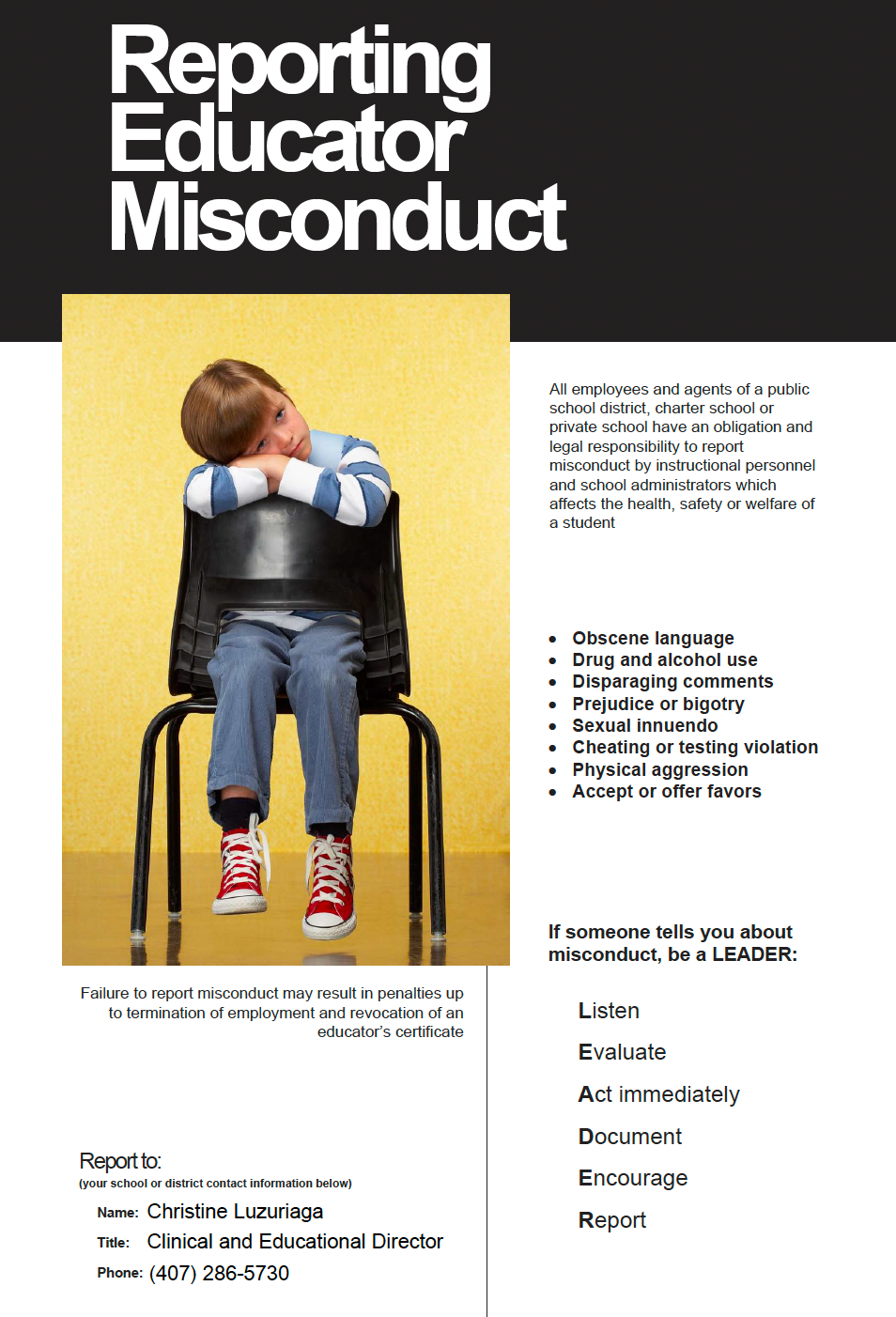
All employees have an obligation and legal responsibility to report misconduct by instructional personnel, educational support employees, clinicians, and school administrators that affects the health, safety, or welfare of a student. Failure to report misconduct may result in disciplinary action, up to and including termination of employment and other applicable consequences.
Reports of professional misconduct should be made to:
Christine Luzuriaga
School Executive Director
(407) 286-5730
christine@affluentlearningcenter.com
William Vega
Director of Operations and Finance
(407) 286-5730
william@affluentlearningcenter.com
Reports of misconduct involving administrators should be made to:
Christine Luzuriaga
School Executive Director
(407) 286-5730
christine@affluentlearningcenter.com
Child Abuse, Abandonment, or Neglect Reporting Requirements
All employees and agents of Affluent Learning Center have an affirmative duty to report all actual or suspected cases of child abuse, abandonment, or neglect.
Report suspected abuse by calling:
1-800-96-ABUSE
Reports may also be submitted online at:
http://www.dcf.state.fl.us/abuse/report/
Who must report abuse?
All employees, instructional personnel, clinicians, educational support staff, administrative personnel, and any individual who witnesses or suspects abuse, abandonment, or neglect are required to report concerns immediately.
Standard of Ethical Conduct
(Adapted from the Code of Ethics of the Education Profession in Florida and Principles of Professional Conduct for the Education Profession in Florida)
All employees of Affluent Learning Center are expected to demonstrate exemplary professional conduct and uphold ethical standards that promote student dignity, safety, independence, learning, and overall well-being.
1. Commitment to Students
Affluent Learning Center values the worth and dignity of every individual, the pursuit of knowledge, dedication to excellence, and the development of each student's potential. All employees shall support an environment where students are treated with respect, provided equal opportunities, and encouraged to achieve meaningful educational and developmental outcomes.
2. Professional Responsibility and Integrity
The primary professional concern of all employees shall be the student and the development of the student's abilities. Employees shall strive for continued professional growth and shall exercise sound professional judgment, ethical decision-making, and integrity in all interactions with students, families, colleagues, and community members.
3. Responsibilities to Students
Employees shall:
- Make reasonable efforts to protect students from conditions harmful to learning and/or to the student's mental, physical health, safety, and well-being.
- Support student independence and avoid unnecessary restrictions that interfere with learning, communication, or skill development.
- Provide instruction and intervention based on individualized student needs and professional standards.
- Avoid intentionally suppressing, distorting, or misrepresenting information relevant to a student's educational or therapeutic program.
- Avoid intentionally exposing students to embarrassment, humiliation, or disparaging treatment.
- Respect and protect each student's legal rights.
- Not harass or discriminate against any student based on race, color, religion, sex, age, national or ethnic origin, political beliefs, marital status, disability, sexual orientation, or social and family background.
- Make reasonable efforts to ensure that each student is protected from harassment, discrimination, intimidation, or mistreatment.
- Not exploit relationships with students or families for personal gain or advantage.
- Maintain confidentiality of personally identifiable information obtained through professional services unless disclosure is required for professional purposes or by law.
Responsibilities to Families, Colleagues, and the Community
Employees shall maintain the trust and confidence of students, families, colleagues, and community members by demonstrating the highest standards of ethical conduct.
Employees shall:
- Maintain honesty and professionalism in all workplace interactions and professional responsibilities.
- Treat colleagues with respect and refrain from discriminatory or harassing behavior.
- Not engage in conduct that creates a hostile, intimidating, abusive, offensive, or oppressive work environment.
- Avoid making malicious or knowingly false statements about colleagues.
- Respect the professional judgment and responsibilities of other team members.
- Communicate accurately and professionally with families, caregivers, and external stakeholders.
- Maintain appropriate professional boundaries with students, families, and coworkers.
Professional Responsibilities
Employees shall:
- Maintain honesty in all professional dealings.
- Accurately represent professional qualifications, credentials, training, and experience.
- Provide truthful information on all employment, educational, clinical, and professional documents.
- Avoid conflicts of interest that interfere with professional responsibilities.
- Not use professional relationships, institutional privileges, or access to students and families for personal gain.
- Not accept gifts, favors, or benefits that could influence professional judgment.
- Protect confidential student and family information.
- Follow all applicable federal, state, and organizational laws, policies, and ethical requirements.
Training Requirement
All instructional personnel, educational support employees, clinicians, administrative personnel, and administrators are required, as a condition of employment, to complete training on these standards of ethical conduct upon hire and annually thereafter.
Training will include expectations regarding:
- Professional ethics and boundaries
- Student safety and welfare
- Confidentiality requirements
- Reporting obligations
- Prevention and reporting of misconduct
- Child abuse, abandonment, and neglect reporting requirements
Reporting Misconduct by Instructional Personnel and Administrators
All employees and administrators have an obligation to report misconduct by instructional personnel, educational support employees, clinicians, or administrators that affects the health, safety, or welfare of a student.
Examples of misconduct include, but are not limited to:
- Obscene or inappropriate language
- Drug or alcohol use affecting professional responsibilities
- Disparaging or demeaning comments toward students or others
- Prejudice, discrimination, or bigotry
- Sexual innuendo or inappropriate conduct
- Cheating or falsifying documentation
- Physical aggression or inappropriate physical contact
- Violations of student confidentiality
- Accepting or offering inappropriate favors or gifts
- Any behavior that compromises student safety or welfare
Reports of misconduct should include documentation of relevant details, including:
- Date, time, and location of the incident
- Individuals involved
- Description of observed behavior or concern
- Any supporting documentation or evidence
Employees should secure relevant evidence immediately when appropriate.
Legally sufficient allegations of misconduct involving Florida-certified educators will be reported to the appropriate regulatory authorities, including the Office of Professional Practices Services.
Policies and procedures for reporting misconduct affecting the health, safety, or welfare of students are available in the Affluent Learning Center office, employee handbook, and on the organization’s website:
https://www.affluentlearningcenter.com
Recognizing Signs of Child Abuse, Abandonment, or Neglect
Signs of Physical Abuse
Possible indicators may include:
- Unexplained bruises, welts, cuts, burns, or other injuries
- Broken bones or repeated injuries
- Withdrawal, depression, or fearfulness
- Fear of returning home
- Avoidance of physical contact
- Aggressive behavior
- Wearing clothing intended to hide injuries
Signs of Sexual Abuse
Possible indicators may include:
- Torn, stained, or bloody clothing
- Difficulty walking or sitting
- Pain, itching, or discomfort in the genital area
- Sexually transmitted infections
- Unusual knowledge of sexual topics
- Fear of a particular person
- Withdrawal, depression, sudden changes in behavior
- Avoidance of physical contact
Signs of Neglect
Possible indicators may include:
- Unmet medical needs
- Lack of supervision
- Poor hygiene
- Inadequate nutrition or appearing underweight
- Frequent tiredness or hunger
- Stealing food
- Excessive need for adult attention
Patterns of Abuse
Serious abuse often involves multiple signs occurring together. While a single indicator may not always represent abuse, patterns of physical, emotional, or behavioral concerns should be taken seriously and reported when suspected.
Liability Protections
Any person, official, or institution participating in good faith in any action authorized or required by law, or reporting in good faith any instance of child abuse, abandonment, or neglect to the appropriate authorities, shall be protected from civil or criminal liability that may otherwise result from such action.
(F.S. 39.203)
An employer who discloses information about a current or former employee to a prospective employer upon request is protected from civil liability unless it is demonstrated by clear and convincing evidence that the information provided was knowingly false or violated a protected civil right.
(F.S. 768.095)
Mandatory Reporting Reminder
All employees of Affluent Learning Center are mandatory reporters and are required to report known or suspected child abuse, abandonment, or neglect to the Florida Department of Children and Families.
Florida Abuse Hotline:
1-800-96-ABUSE
Individuals who make reports in good faith are protected from retaliation and liability under Florida law.
(F.S. 39.203)